Last updated October 15, 2026
Seasonal ADU Care for Ventura: Year-Round Homeowner’s Guide
Ventura doesn’t announce its seasons with snowdrifts or 20-degree mornings, and that’s exactly why ADU maintenance gets skipped. The danger isn’t a hard freeze cracking a pipe. It’s the slow, quiet damage: Santa Ana winds working roof flashing loose between September and November, then January rains turning those loose spots into leaks. This guide walks you through what to check, when to check it, and what actually needs to be on your calendar each month in Ventura’s coastal climate. You’ll learn the three weather cycles that cause the most preventable damage, how detached ADUs differ from garage conversions, and which tasks matter more than you think.
Quick Answer
Ventura ADU owners should follow a three-season maintenance calendar tied to Santa Ana winds (September – November), the winter rain window (December – March), and marine layer humidity (May – August). The single highest-value task is a roof and flashing inspection in late September before wind season fully arrives. Most year-round ADU maintenance in Ventura costs between $200 and $800 annually when caught early, and five figures when deferred.
Table of Contents
- Why Ventura’s Weather Pattern Breaks the Four-Season Maintenance Model
- Month-by-Month ADU Maintenance Calendar for Ventura
- Santa Ana Wind Prep: The September Checklist
- Winter Rain Readiness for Clay-Heavy Ventura Soils
- Marine Layer Season: Condensation, Mini-Splits, and Threshold Care
- Maintenance Differences: Detached ADUs vs. Garage Conversions vs. Attached Additions
- How Prefab ADUs Change the Maintenance Equation
- Common Mistakes to Avoid
- When to Call a Professional
- Frequently Asked Questions
- The Bottom Line
Why Ventura’s Weather Pattern Breaks the Four-Season Maintenance Model
Here’s the thing about Ventura: the annual temperature swing is mild enough that a generic seasonal maintenance guide written for someone in Ohio or Michigan tells you almost nothing useful. Ventura’s real seasons are driven by three distinct weather cycles that don’t line up with calendar seasons. The Santa Ana wind season runs roughly September through November, peaking in October. The rain window concentrates between December and March, with January and February delivering most of the year’s precipitation. And the marine layer cycle runs late spring through mid-summer, bringing fog, condensation, and elevated humidity during the exact months when temperatures finally climb. Each of these cycles stresses different parts of an ADU. Santa Anas attack the roof, exterior vents, and any loose flashing. Winter rains expose drainage failures, grading problems, and every gap the winds created. The marine layer creates condensation on windows, door thresholds, and inside crawl spaces. If you’ve been treating ADU maintenance as a once-a-year spring cleaning project in Ventura, you’re running at least two full weather cycles behind schedule. The fix is a maintenance calendar built around these three cycles, not around seasons that don’t exist here.
We’ve walked hundreds of Ventura property owners through ADU maintenance, and the pattern is consistent. ADU builders in Ventura see the same call patterns every year: emergency roof leaks in February, mold complaints in July, and wind damage reports in November. The damage in each case traced back to a weather cycle that landed two to three months earlier. That delay between cause and symptom is what makes Ventura’s climate feel so deceiving. By the time you notice the leak, the flashing has been failing since October.
Month-by-Month ADU Maintenance Calendar for Ventura
This calendar maps maintenance to Ventura’s actual weather patterns. Each month includes the specific tasks that matter most during that window, not a generic list of homeowner chores. Keep this somewhere visible: a garage wall, a phone note, or taped inside a utility cabinet.
September: Santa Ana Preparation Month
- Walk the roof edge and flashing lines. Look for lifted shingles, cracked sealant at roof penetrations, and loose metal flashing around vents, skylights, and the chimney if your ADU has one. Santa Ana gusts in Ventura regularly exceed 40 mph, and loose flashing becomes a wing at those speeds.
- Clear gutters and downspouts. Ventura’s dry summer months let leaves and sediment accumulate. A clogged gutter in October becomes a water intrusion path in January.
- Check all exterior vent covers. Dryer vents, bathroom fan exhausts, and range hood terminations need intact covers and tight mounting. Santa Ana winds will rip off anything that’s loose and deposit rain into the opening later.
- Secure or remove loose yard items. Planters, hose reels, and patio furniture near the ADU become projectiles in wind events. Store them or anchor them before October.
October: Peak Wind Vigilance
- Recheck anything that rattled during the first Santa Ana event. After the first strong wind day, walk the ADU exterior and listen for anything that moved. If a vent cover or piece of trim is now wobbly, that’s your signal to secure it before the next event.
- Inspect window and door seals. The combination of wind-driven rain and pressure differentials finds every gap. Run a hand around window and door frames looking for daylight, or use an incense stick to detect air movement.
- Check the crawl space vents. If your ADU sits on a raised foundation, the crawl space vents are your moisture risk point. Make sure the vent screens are intact and the covers are in place before the rains start.
November: Post-Wind, Pre-Rain Reset
- Run the full exterior audit. By now the winds have had their way. Walk the property with a camera and photograph every area that looks concerning: lifted corners, separated trim, anything the wind exploited. These photos become your record for insurance or a contractor conversation.
- Clean gutters and downspouts one more time. The Santa Anas deposit an enormous amount of debris in late October and November. Gutters need a final clear before the rain window opens in earnest.
- Test the drainage swales and downspout extensions. Make sure water flows away from the ADU foundation at least three feet. In Ventura, a downspout that dumps water against the foundation on clay soil is a slow-motion foundation problem.
December: Rain Window Opens
- Walk the property during or immediately after the first measurable rain. This is the single most valuable rain-season task. You’ll see exactly where water pools, where it sheets against the ADU, and where gutters overflow. No dry-weather inspection reveals this.
- Check door thresholds from the outside. Confirm that water drains away from the door, not toward it. A threshold that allows water to pool against the door will eventually rot the frame or seep under the flooring.
- Inspect the roof from inside the attic or crawl space. Look for dark staining, damp insulation, or daylight through the decking. If you see moisture, mark the spot and track it after the next rain to determine the entry point.
January – February: Peak Rain Monitoring
- Check under sinks and around the water heater after every major storm. Ventura’s winter rain puts hydrostatic pressure on foundations, which can shift plumbing connections and cause slow leaks at fittings.
- Monitor for mold and mildew around windows and in closets. High humidity combined with cooler indoor temperatures creates condensation on poorly sealed glass and exterior walls.
- Keep crawl space vents clear and open during dry spells. Ventura’s clay-heavy soil holds moisture for weeks after rain. Your crawl space needs airflow to dry out between storms.
March: Transition Cleanup
- Inspect for storm damage while it’s still fresh evidence. Before the marine layer arrives and the weather warms, take inventory of what the winter exposed: loose flashing, cracked seals, drainage that failed. This is the window to fix it before the condensing season arrives.
- Flush the mini-split drain lines. Winter rain and cooler temperatures slow evaporation in condensate lines. A thorough flush before the cooling season starts prevents a backed-up line in July.
- Check the roof one final time before the dry season. Any winter storm damage becomes obvious under good light and dry conditions. Fix it now when contractor availability in Ventura is generally better than during the January emergency rush.
April – May: System Checks Before Humidity
- Service the mini-split if it has not been serviced this year. Clean or replace filters, verify the drain line flows, and check that the outdoor unit has at least 12 inches of clearance around all sides. A dirty mini-split in Ventura’s humid marine layer season works harder and grows mold faster.
- Inspect all exterior caulk and sealant joints. The winter rains and March sun cycle degrades caulk quickly. Re-seal window perimeters, door frames, and any exterior penetrations before the fog season arrives.
- Check exterior paint and siding for moisture damage. Any bubbling, peeling, or staining indicates moisture intrusion from the rainy season. Address these before the marine layer locks in humidity.
June – August: Marine Layer Management
- Run the bathroom exhaust fan for at least 20 minutes after showers. Ventura’s morning fog and elevated humidity mean moisture has nowhere to go if the ADU isn’t actively ventilated. This is the single cheapest mold prevention step available.
- Check window condensation at dawn. If interior window surfaces are wet every morning, the ADU has an air-sealing or ventilation problem. Persistent condensation on the interior side of windows during the marine layer months means the building envelope is trapping moisture.
- Verify the crawl space is dry by mid-July. If the crawl space still feels damp in July, after months without rain, the moisture source is condensation or groundwater, not rain. Address it before the next rainy season compounds the problem.
- Monitor mini-split performance. As the marine layer lifts and actual heat arrives, the mini-split works hardest. Reduced cooling output or water dripping from the indoor unit indicates a clogged drain line or low refrigerant.
Santa Ana Wind Prep: The September Checklist
Santa Ana winds are the most destructive weather event Ventura ADUs face on a recurring basis, and they arrive with little warning. The winds originate in the high desert, compress as they descend through the Santa Monica Mountains and the Ventura foothills, and accelerate through the canyons that empty into the coastal plain. In practical terms, your ADU gets hit by sustained winds that can exceed 40 miles per hour and gust higher. The winds are also exceptionally dry, which means they desiccate sealants and make everything brittle right before the rain season begins.
Here’s the September checklist, step by step:
- Roof edge inspection. Walk the roof edge and look for lifted shingles, exposed nails, and cracked sealant. The wind attacks the roof edge first, and any gap invites wind-driven rain later. Focus on the corners, where wind pressure is highest.
- Flashing check at every penetration. Every pipe, vent, and skylight protruding through the roof is a potential wind catch. If the flashing lifts, water follows. Press down on the flashing to confirm it’s seated, and check the sealant bead around each penetration.
- Vent cover inspection. Exterior wall vents for the dryer, bathroom fan, and range hood need intact covers that close against reverse pressure. A missing or damaged vent cover lets the wind pressurize the ADU envelope and blows conditioned air out.
- Loose item audit. Walk the ADU perimeter and identify anything that can become airborne: potted plants, trash cans, lightweight chairs, decorative items. Anchor them or plan to bring them inside before the next wind event.
- Tree and limb assessment. Look at any branches overhanging the ADU roof. Dead or weakened limbs will come down in a Santa Ana event. Trim anything that could reach the roof on the way down.
In our experience building and maintaining ADUs in Ventura, the properties that fare best during Santa Ana season share one habit: they perform this checklist in late September, before the first strong event, and they repeat the exterior walk after the first significant wind day. The first event tells you exactly what’s loose. The second event exploits whatever you didn’t fix.
Winter Rain Readiness for Clay-Heavy Ventura Soils
Ventura’s soil is heavy clay in many residential areas, particularly in the older neighborhoods and foothill-adjacent pockets. Clay soil expands when wet and contracts when dry, and repeat wet-dry cycles put steady, slow pressure on foundations, slabs, and underground plumbing. The practical effect for ADU owners: water management around the structure is not optional. It’s the primary determinant of whether an ADU foundation stays stable over a decade.
Here’s what to check and maintain during the December – March rain window:
- Downspout extensions must extend at least three feet from the ADU. Anything less means water discharges into the clay soil directly against the foundation, which concentrates expansion and contraction right where it matters.
- Drainage swales need a visual check after November’s winds. Swales filled with wind-blown debris won’t channel water away. Clear them and verify they still slope away from the structure at a minimum of one inch of fall per four feet of run.
- Crawl space vents should remain open during dry weather between storms. Ventura’s clay soil holds moisture for weeks after rain. The crawl space needs constant airflow to dry out, otherwise the rim joists, subfloor, and any wood framing sit in a humid microclimate that promotes rot and mold.
- Foundation perimeter should stay free of piled soil or mulch. Anything that holds moisture against the foundation accelerates the wet-dry cycle problem. Keep a six-inch clear zone around the ADU foundation.
- Exterior grade must slope away from the ADU on all sides. Over time, soil settles against foundations, creating flat spots or even reverse grade. Check after the first rain of the season and correct any areas where water is pooling against the structure.
For ADUs built on a slab foundation, the primary risk shifts from crawl space moisture to hydraulic pressure at the slab edge. The same drainage principles apply: a downspout that dumps water at the slab edge will eventually find its way under the slab, where clay soil expansion can crack the slab or push against underground plumbing. The fix is always the same: move water at least three feet away from the structure, keep gutters clear, and verify drainage paths every November.
Marine Layer Season: Condensation, Mini-Splits, and Threshold Care
Ventura’s marine layer runs from roughly May through August, and it creates the exact conditions that homeowners least suspect: mornings with 90% or higher relative humidity, afternoons that warm enough to create a strong temperature differential, and buildings that never quite dry out. The marine layer is why Ventura ADUs get condensation on windows even when it hasn’t rained in months, and why mini-split drain lines clog in July, not January.
The three problem areas during marine layer season:
Window Condensation
Condensation forms when warm, humid air contacts a cold surface. In a Ventura ADU during the marine layer months, that cold surface is typically single-pane or older double-pane windows in the morning hours, before the sun burns off the fog. The fix is a combination of ventilation and air sealing: run bathroom exhaust fans longer, crack a window or use a ventilation fan during morning fog hours, and inspect window seals for gaps that create localized cold spots. Persistent daily condensation on the interior side of windows means the ADU envelope is trapping moisture, and that moisture eventually finds its way into wall cavities and window frames.
Mini-Split Drain Lines
A mini-split running in cooling mode produces condensate. That water drains through a line that exits the building, and in Ventura’s marine layer season, the line is more prone to clogs because airborne dust and pollen mix with the higher humidity and create sludge. A clogged drain line causes the indoor unit to leak, often dripping water down the wall. The simple prevention is to flush the line in March, before the marine layer arrives, and to inspect the outdoor condensate discharge point for signs of proper flow during the summer months. If you see no water dripping from the discharge when the unit is cooling, the line is likely already clogged.
Door Thresholds
Thresholds sit at the intersection of interior conditioned air and exterior marine layer humidity. The high humidity on the exterior side, combined with occasional rain in the transitional months, means any threshold that is not properly flashed and sealed will eventually show signs of water damage: soft wood, peeling paint, or rusting screws. Check all exterior door thresholds each May for signs of moisture intrusion, and inspect the weather stripping for compression or gaps. A simple threshold check takes five minutes and prevents the slow rot that becomes a full door replacement.
Maintenance Differences: Detached ADUs vs. Garage Conversions vs. Attached Additions
The type of ADU on your Ventura property changes the maintenance picture meaningfully. What matters for a detached unit in the backyard is not the same as what matters for a garage conversion or an attached addition. Here’s the breakdown.
Detached ADUs
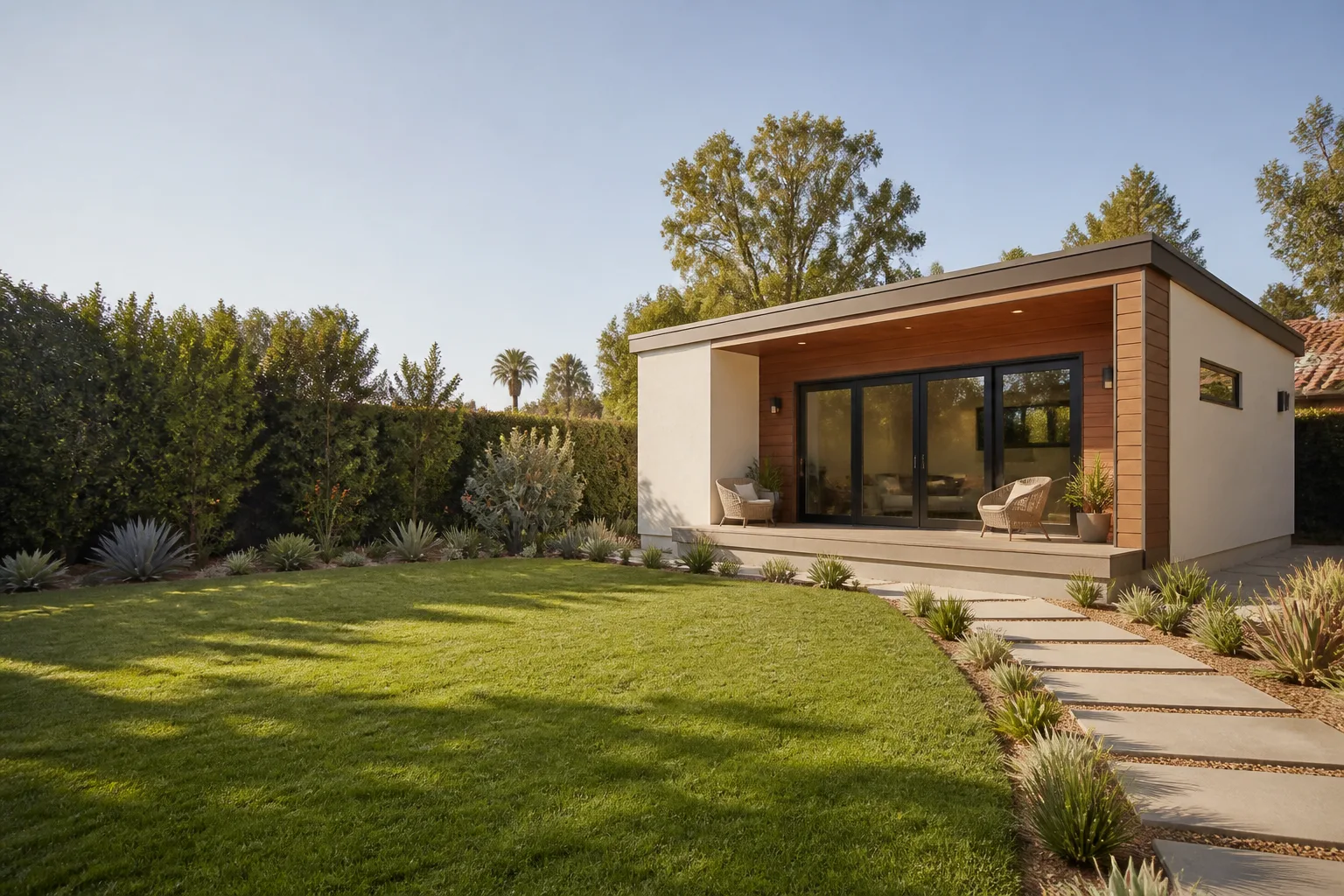
A detached ADU stands alone, which means all four walls, the roof, and the foundation are exposed to the weather independently. Detached units have the highest maintenance requirement of the three ADU types because there’s no shared building envelope to buffer from the elements. The roof is fully exposed, so Santa Ana prep matters more. The foundation perimeter is fully exposed, so drainage and grading matter more. The unit also typically has its own mini-split, its own water heater, and its own small electrical panel, all of which need individual attention. The advantage of a detached ADU is that maintenance problems are isolated: a leak in the detached unit does not affect the primary residence. The downside is that nothing on a detached ADU benefits from the thermal mass or moisture buffering of an attached structure.
Garage Conversions
A garage conversion brings a unique maintenance profile because the original structure was not built as living space. The slab was typically poured for vehicle storage, which means slope and drainage were designed for a garage door, not for a wall with a door and windows. Ventura garage conversions frequently require attention to moisture management in the first few years because the original slab design allowed water to flow toward the garage door opening. Once that opening is framed in, the water path is blocked, and the water has nowhere to go. Check the slab perimeter drainage thoroughly, especially at the old garage door location. Also check the original garage walls: many garage buildings in Ventura were built with minimal insulation and no moisture barrier, so condensation during marine layer season can be more pronounced in a conversion than in a purpose-built ADU.
Attached Additions
An attached addition shares one or more walls, the roof line, and the foundation with the primary residence. The shared elements reduce the exposed surface area, which lowers some maintenance requirements. The roof, however, is a special case: where the addition roof ties into the existing roof, the transition creates a flashing and waterproofing joint that is the single most failure-prone point on any addition. In Ventura, roof transitions on attached additions are the most common source of leaks during the winter rain window, typically because the flashing was installed correctly but has shifted over multiple wet-dry cycles. Additions also share the primary residence’s drainage system, which means a downspout failure on one side of the house affects both structures. Include the addition’s roof transition and shared drainage points in your September and November checklists.
If you’re planning an addition in Ventura or considering a room addition rather than a standalone unit, factor the maintenance differences into your planning conversation from the start. A well-built roof transition and proper drainage solve half of the maintenance burden before construction is complete.
How Prefab ADUs Change the Maintenance Equation
Prefab ADUs are built differently from site-built units, and that difference shows up in maintenance. A prefab unit from a brand like Cover or Dvele arrives with factory-built wall panels, pre-installed windows, and factory-sealed joints. The building envelope is assembled under controlled conditions, which means the weakest point of a site-built structure, the thousands of small field-applied seals and flashing details, is replaced by a smaller number of engineered joints that were tested before they left the factory.
That does not mean prefab ADUs are maintenance-free. It means the maintenance profile shifts. Instead of inspecting dozens of field-applied sealant joints around windows and doors, a prefab owner checks the panel seams: the vertical and horizontal joints where panels meet. Those seams are sealed with factory gaskets or applied sealant, and they are the primary exterior maintenance point on a prefab unit. The roof, depending on the brand, may be a single membrane or a panelized system with a limited number of joints. A factory-built roof with fewer joints has fewer potential leak points, but each joint still needs a September check before Santa Ana season.
Brands like Mighty Buildings and Boxabl use panel systems with advanced materials that resist moisture absorption, which changes the marine layer season calculus. The panels themselves don’t absorb water the way wood framing does, but the threshold details, door seals, and mini-split installation points still need the same condensation checks as any other ADU. If you’re considering a prefab ADU in Ventura, ask the builder specifically about the panel seam locations, the sealant warranty terms, and what the manufacturer recommends for seasonal inspection. At Benson ADU Ventura, we build with several of these prefab systems and provide owners with a written maintenance schedule specific to the brand they select.
Common Mistakes to Avoid
- Waiting for the January rains to check roof flashing. By the time Ventura’s winter rains arrive, the Santa Ana winds have already done the damage that allows water in. The leak you discover in January was created in October. Check the roof in September, before the winds.
- Ignoring the downspout extensions. A downspout that dumps water against the ADU foundation on Ventura’s clay soil is a structural problem in slow motion. Three feet of extension is the minimum, and the cheap plastic extensions from the hardware store count if they’re actually in place and not crushed.
- Closing crawl space vents in winter. Ventura’s climate does not warrant closing crawl space vents. The crawl space needs airflow all year, especially during the rain window when soil moisture peaks. Closed vents in December create the humid microclimate that rots floor framing.
- Treating a garage conversion like a purpose-built ADU. The original slab drainage and wall construction of a garage were not designed for living space. If you own a conversion, check the old garage door threshold and slab perimeter drainage twice a year, not once.
- Skipping mini-split maintenance until it leaks. A mini-split that drips water down the wall in July has likely had a slowly clogging drain line since March. The flush takes 20 minutes. The wall repair takes a weekend.
- Assuming the marine layer is harmless because there’s no rain. Persistent condensation is water intrusion by another means. Mold growth from marine layer condensation is one of the most common issues we see in Ventura ADUs that were built tight but never ventilated properly.
- Deferring a small flashing repair because “it held up last year.” Santa Ana winds expose weaknesses. Rain exploits them. A loose piece of flashing in September is a $150 fix. The same flashing after a January storm has driven water into the wall is a multi-thousand-dollar repair that includes drywall, insulation, and possibly framing.
When to Call a Professional
Some maintenance tasks are right for a careful homeowner with a ladder and basic tools. Others are not. Call a professional if you see any of these: water staining on interior ceilings or walls that was not there before the rainy season, persistent condensation that appears on interior window surfaces every morning during marine layer season, any roof leak that you cannot trace to an obvious cause, visible foundation cracks wider than a hairline, a crawl space that remains damp into July, or a mini-split that is leaking water despite a clean drain line. Also call a professional rather than attempting roof work if the ADU roof pitch is steep or the roof is more than one story above grade. Falling from a roof is never worth the inspection you were trying to do yourself. Benson ADU Ventura offers free estimates in Ventura. Call (350) 207-2506 and we’ll take a look at the issue and give you a written price before any work starts.
Frequently Asked Questions
You should inspect the ADU roof twice per year in Ventura: once in September before Santa Ana wind season arrives, and once in March after the winter rain window closes. The September inspection catches loose flashing and damaged shingles before the winds can exploit them. The March inspection catches storm damage while the evidence is fresh and before contractor schedules fill up for summer. If you have a ridge or valley on your roof where two planes meet, check those areas carefully during each inspection.
Annual ADU maintenance in Ventura typically costs between $200 and $1,500 depending on what needs attention. The low end covers basic tasks: gutter cleaning twice a year, a DIY flush of the mini-split drain line, and visual inspections. The mid range of $500 to $1,000 typically includes a professional roof and flashing inspection, caulk and sealant touch-ups, and a mini-split service call. The high end of $1,200 to $1,500 includes repairs to flashing, drainage, thresholds, or the roof. Call us at (350) 207-2506 for an exact quote for your Ventura property. Estimates are free and always in writing.
Prefab ADUs generally need less field sealing maintenance than site-built ADUs because the panels and joints are built in a factory under controlled conditions. But prefab units still need roof, drainage, mini-split, and threshold maintenance. The maintenance focus shifts from dozens of small field-applied sealant joints to a smaller number of panel seams and the points where mechanical systems penetrate the building envelope.
Condensation on ADU windows in July in Ventura is caused by the marine layer, which brings morning humidity levels above 90% combined with cool overnight temperatures. Warm, humid exterior air contacts the cooler window surfaces and condenses. Persistent daily condensation on the interior side of windows means the ADU is trapping moisture and needs better ventilation or air sealing.
After a Santa Ana wind event in Ventura, check the roof flashing at every penetration, all exterior vent covers, any loose trim or siding, and the areas around windows and doors where wind-driven debris may have struck. Listen for anything rattling during the next event, which indicates a component that has worked loose. Address every loose item before the next wind event, because the winds will exploit whatever you didn’t fix.
Yes. Garage conversion ADUs in Ventura frequently have drainage issues at the old garage door location because the original slab was poured to slope toward the garage door opening for vehicle drainage. Once that opening is framed in, the water path is blocked, and water pools against the new wall. The fix requires establishing positive drainage away from the structure at the old garage door threshold. Call (350) 207-2506 for an assessment if you’re seeing water at that location.
The Bottom Line
Ventura ADU maintenance is not complicated, but it is specific. The city’s three weather cycles, Santa Ana winds, winter rains, and the marine layer, each create predictable damage patterns that a generic four-season checklist misses entirely. The highest-value habit is the September roof and flashing inspection, before wind season arrives. The second-highest is walking the property during the first real rain to see where drainage actually fails. Together, those two actions prevent most of the expensive damage ADU owners in Ventura experience. If you’re unsure where to start or you’ve found something that concerns you, call Benson ADU Ventura at (350) 207-2506 for a free estimate. We’ll put a written price in front of you before any work begins.
Written by Troy Eastman, Owner at Benson ADU Ventura, serving Ventura since 2006.