Last updated October 15, 2026
DIY vs Professional ADU: The Ventura Homeowner’s Decision Guide
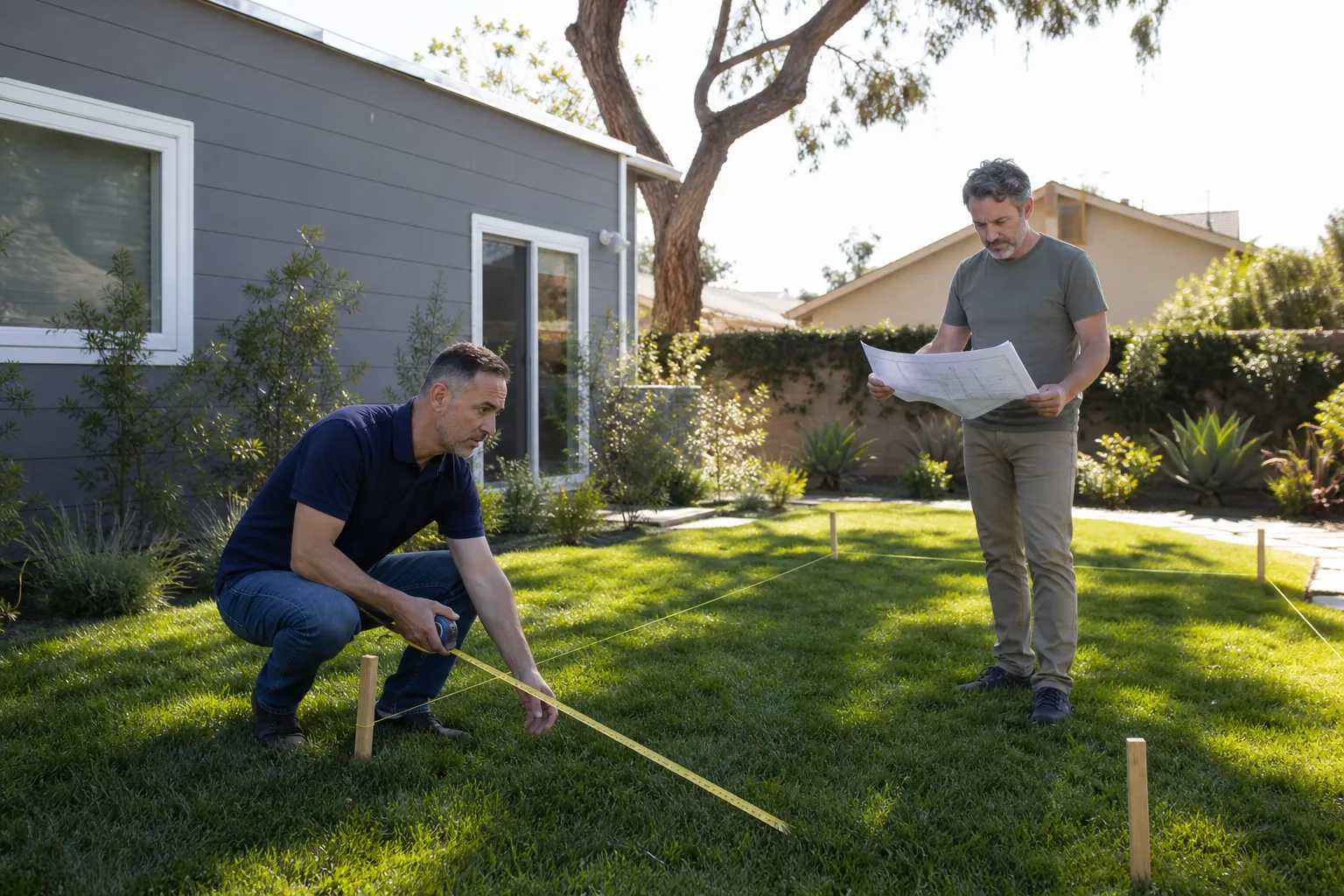
Here’s a fact most DIY ADU guides conveniently skip: when you pull an owner-builder permit in California, the state requires you to sign a disclosure that gets attached to your property deed. It warns future buyers that the structure was built by the homeowner, not a licensed contractor. That single piece of paper changes how lenders appraise your property, how buyers finance it, and how much they’re willing to offer. This guide walks through the real decision points for a Ventura homeowner: what you can legally build yourself, what you should never touch, what prefab actually hands you, and where the honest savings are. We’ll name prices, timelines, and code realities without the YouTube optimism.
Quick Answer
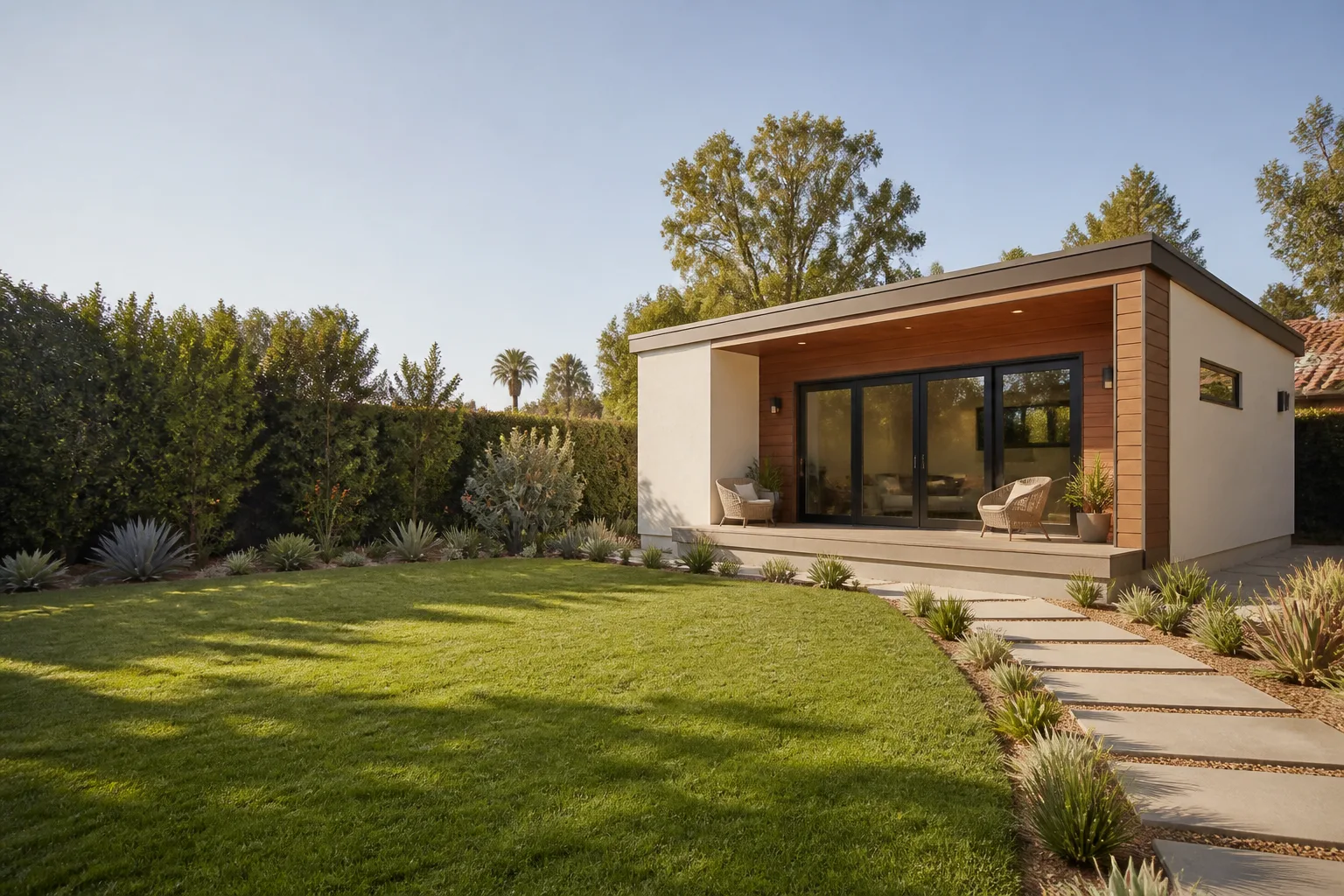
For most Ventura homeowners, the smart split is hybrid: hire a licensed contractor for foundation, framing, electrical, plumbing rough-in, and stucco or siding, then self-perform finish work like paint, trim, flooring, and landscaping. A full DIY ADU in California is legally possible under an owner-builder permit, but the deed disclosure, lender scrutiny, and liability exposure usually erase the savings-see our How to Hire a ADU Contractor in Ventura: A Step-by-Step Guide for how to vet professionals. A licensed build with a written price and warranty typically costs $350 – $550 per square foot in Ventura County, while owner-builder projects that go wrong often end up costing more than a professional build would have from day one.
Table of Contents
- California Owner-Builder Rules: What the Permit Actually Means
- The Deed Disclosure Problem Nobody Mentions
- The Honest Savings Math: Where DIY Saves and Where It Bleeds
- The Skills-and-Risk Matrix: Matching Tasks to Realistic DIY Ability
- The Prefab Middle Path: What Abodu and Cover Actually Hand You
- Insurance and Lending: What Your Policy Won’t Cover During an Owner-Builder Build
- Ventura-Specific Factors: Climate, Codes, and Market Reality
- Common Mistakes to Avoid
- When to Call a Professional
- Frequently Asked Questions
- The Bottom Line
California Owner-Builder Rules: What the Permit Actually Means
California Health and Safety Code Section 50662 allows a property owner to act as their own general contractor on residential construction, including ADUs. You file the permit under your own name, you assume responsibility for code compliance, and you can hire subcontractors to do specific trades. That part is straightforward. The part most people miss is the liability structure: when you’re the owner-builder, you are legally the general contractor. That means you carry the responsibility for worker injuries, code violations, scheduling failures, and defects, not a licensed builder with insurance.
Here’s what an owner-builder permit in Ventura actually allows and restricts:
- You can hire licensed subcontractors for electrical, plumbing, HVAC, and roofing while still acting as the owner-builder. You coordinate them; you don’t do the work.
- You cannot hire unlicensed labor to perform work that requires a contractor’s license. A handyman can paint, but they cannot wire a panel or run gas lines.
- You must occupy the structure or own it outright at the time of permit issuance. You cannot act as an owner-builder on a property you intend to flip immediately. If you sell within a certain window, the buyer’s lender will scrutinize the build history.
- You bear worker’s comp responsibility if you hire anyone who gets hurt on site. A licensed contractor carries worker’s comp insurance. You, as an owner-builder, probably don’t.
- The deed disclosure is mandatory if you sell the property. You cannot remove it by doing a second permit later.
In Ventura, the city’s building department processes owner-builder permits through the same plan-check system as contractor permits. The plan review timeline is not faster for DIY. In our experience, owner-builder plan checks often take longer because the plans come back with correction comments that a licensed designer would have avoided. That delay costs real money if you’re paying a mortgage on an unused yard.
The takeaway: legal does not equal smart. California lets you build an ADU yourself. That permission comes with a stack of obligations most homeowners don’t discover until a problem shows up.
If you’re weighing an ADU against adding square footage to the main house, the decision framework changes. Read more about adding a home addition in Ventura and how the permit process differs.
The Deed Disclosure Problem Nobody Mentions
The owner-builder disclosure is a California Civil Code Section 1102.6 requirement. When you sell a property with an owner-built structure, you must attach a written notice to the purchase contract and record it against the property title. The disclosure states, in plain language, that the structure was built by the owner and may not have been constructed by a licensed contractor with the same warranties and consumer protections.
Here’s what that disclosure does in practice:
- Appraisers treat the ADU differently. An owner-built ADU often gets valued at the cost of materials plus a modest labor allowance, not at the full market value a permitted, contractor-built ADU commands. An appraiser comparing your home to a neighbor’s contractor-built ADU must adjust for the difference. That adjustment is rarely small.
- Lenders get skittish. FHA, VA, and many conventional loan programs require that any ADU on the property meet specific construction standards. An owner-built ADU with a disclosure on file triggers additional review. Some lenders will not finance a property with an owner-built ADU at all. Others will require a structural engineer’s certification before underwriting. Either way, your buyer pool shrinks.
- Buyers negotiate harder. A savvy buyer’s agent will pull the permit history and find the disclosure. They’ll use it to argue the ADU is worth less or ask for a repair credit. You saved $30,000 on labor; the buyer now wants $25,000 off the price.
- Insurance claims get complicated. If a defect in the ADU causes damage, your homeowner’s carrier may deny the claim or subrogate against you as the builder. With a licensed contractor, the contractor’s liability insurance and workmanship warranty absorb that exposure. With an owner-builder, you are the warranty.
The disclosure is not a footnote. It is a permanent record that travels with the deed. A professional ADU build avoids it entirely because the permit is filed under a licensed contractor’s name, and the unit carries the contractor’s warranty and insurance trail. For a Ventura homeowner planning to sell in 5 to 10 years, that difference is material.
For homeowners considering a detached ADU versus an attached addition, the resale math changes again. Our guide to ADU building in Ventura covers how each option appraises.
The Honest Savings Math: Where DIY Saves and Where It Bleeds
Let’s put real numbers on the table. A 600-square-foot one-bedroom ADU in Ventura costs roughly $350 to $550 per square foot for a full professional build, including permits, plans, site work, utilities, and finish. That’s $210,000 to $330,000. A prefab path can come in around $300 to $450 per square foot depending on the brand and site conditions.
Here’s the actual savings breakdown if you self-perform specific parts of the build:
Where DIY Labor Actually Saves Money
- Painting: Interior and exterior painting on a 600-square-foot ADU is about $6,000 to $9,000 in labor. A homeowner with patience and a sprayer can do this over two weekends and buy $800 to $1,500 in materials. Honest savings: $4,500 to $7,000.
- Flooring: Installing LVP or laminate over a level subfloor is a beginner-to-intermediate job. Labor for 600 square feet runs $3,500 to $5,000. Material kit: $2,000 to $3,500. Honest savings: $1,500 to $3,000, provided the subfloor is flat.
- Trim and baseboard: Labor is often $2,500 to $4,000. A miter saw, nail gun rental, and materials run $600 to $1,000. Honest savings: $1,500 to $3,000.
- Landscaping and hardscape around the ADU: Ground prep, gravel, pavers, and planting beds are genuinely DIY-friendly. Professional landscape installation for an ADU lot line can run $8,000 to $15,000. DIY materials: $2,000 to $4,000. Honest savings: $4,000 to $10,000.
- Demo of an old shed or garage slab: If the city allows it and there’s no asbestos, renting a dumpster and doing the teardown yourself saves $3,000 to $6,000. But check for asbestos in old siding and flooring first. Pre-1980 structures in Ventura often have it.
Where DIY Creates Liability That Erases the Savings
- Foundation and slab work: A failed slab in Ventura’s expansive soil means cracks, moisture intrusion, and a ruined interior. Repair cost after the fact: $25,000 to $60,000. The savings from DIYing this: zero. You can’t legally pour a structural slab without approved plans, and the concrete subcontractor requires a licensed GC for warranty purposes.
- Electrical rough-in and panel work: A 100-amp subpanel, branch circuit wiring, and fixture rough-in require a licensed electrician in Ventura. Wiring errors are a fire risk. Insurance companies look for homeowner electrical work after a claim. Savings from doing this illegally: none, because you cannot pull the electrical permit without a licensed electrician’s signature.
- Plumbing rough-in: Under-slab drainage and supply line rough-in must pass inspection before the slab is poured. A single failed pressure test sets the project back weeks. A licensed plumber in Ventura charges $8,000 to $14,000 for an ADU rough-in. The cost of redoing an amateur rough-in after slab pour: $15,000 to $30,000.
- Framing: A framing error that shifts a wall by two inches cascades through every trade that follows: electrical boxes, plumbing vent placement, window install, roof pitch. Fixing a framing mistake after drywall is up costs more than the framing labor was worth.
- Stucco and siding on Ventura coastal exposure: Improperly flashed stucco or siding on a home within a few miles of the ocean wicks moisture. Ventura’s marine layer and salt air accelerate rot in any gap or seam. A wall that fails in year three costs $10,000 to $20,000 to strip and redo.
The honest bottom line: a disciplined DIY homeowner can save $12,000 to $22,000 on finish work without meaningfully increasing risk. Attempting to self-perform structural, electrical, or plumbing trades saves nothing on paper because you still need licensed subs for the permits, and it creates liability exposure that dwarfs the theoretical savings.
The Skills-and-Risk Matrix: Matching Tasks to Realistic DIY Ability
Here’s the part where most guides get vague. Let’s match every major ADU task to a realistic skill level and time commitment, not what a 10-minute YouTube video makes it look like.
| Task | Realistic Skill Level | Time for One Person | Risk if Done Wrong | DIY Verdict |
|---|---|---|---|---|
| Interior painting | Beginner | 2 – 3 weekends | Low; repaint is annoying but cheap | Good DIY candidate |
| LVP / laminate flooring | Beginner to intermediate | 2 – 4 days | Low if subfloor is flat; moderate if not | Good DIY candidate with prep |
| Baseboard and trim | Beginner | 1 – 2 days | Low; gaps are cosmetic | Good DIY candidate |
| Interior door hanging | Intermediate | 1 day per door | Moderate; a badly hung door binds forever | Cautious DIY |
| Tile backsplash | Intermediate | 2 – 3 days | Low to moderate; waterproofing matters | Cautious DIY |
| Drywall hanging | Intermediate | 1 – 2 weeks for an ADU | Moderate; seams show if you rush | Cautious DIY |
| Drywall taping and finishing | Advanced | 1 – 2 weeks | High; bad tape jobs look terrible under light | Hire this out |
| Insulation install | Intermediate | 2 – 3 days | Moderate; gaps kill energy performance | Cautious DIY |
| Framing | Advanced | 3 – 5 weeks | Very high; errors cascade to every trade | Hire this out |
| Electrical rough-in | Licensed only | 1 week | Very high; fire risk, insurance denial | Must hire licensed electrician |
| Plumbing rough-in | Licensed only | 1 week | Very high; slab leaks are catastrophic | Must hire licensed plumber |
| Stucco / siding | Advanced | 2 – 4 weeks | High; coastal moisture intrusion is slow and costly | Hire this out |
| Roofing | Advanced | 3 – 5 days | Very high; fall risk plus leak risk | Hire this out |
| Landscaping / hardscape | Beginner to intermediate | 2 – 4 weekends | Low; regrade issues are fixable | Good DIY candidate |
Reading this matrix honestly requires divorcing yourself from the idea that you’ll save time. DIY finish work on a 600-square-foot ADU will take you 8 to 12 weekends. That’s 16 to 24 full days of your life. If you work a full-time job, you’re giving up every Saturday and Sunday for a quarter of the year. Some people love that trade. Most don’t. The question is whether the $12,000 to $22,000 in savings is worth 200 hours of your time. That’s $60 to $110 per hour, which is not bad, but it only holds if the work turns out right the first time.
The Prefab Middle Path: What Abodu and Cover Actually Hand You
There’s a third option between full DIY and traditional site-built construction that Ventura homeowners are increasingly choosing: prefab ADUs. The idea is that a factory builds the structural shell, delivers it to your lot, and a local contractor handles site prep, utilities, and finishing. It’s a middle path that removes some risk without requiring you to pick up a hammer.
Here’s what actually happens, because the marketing versus reality gap is wide.
What Abodu Delivers
Abodu builds a complete unit in their factory: framing, insulation, windows, doors, interior drywall, electrical and plumbing rough-in, kitchen, and bath fixtures. The unit arrives on a trailer and gets craned onto a prepared foundation. What Abodu does NOT do: site work, foundation, utility connections from the street or main house, final hookups, inspection coordination. In Ventura, a local contractor must handle the foundation pour, sewer and water connections, electrical service tie-in, and the final city inspection. Abodu’s factory quality is genuinely high, but the last 20 percent of the project happens on site and requires a licensed contractor. The total cost for an Abodu studio or one-bedroom in Ventura typically lands between $250,000 and $400,000, depending on site conditions and finish level.
What Cover Delivers
Cover takes a different approach: they build the unit as a series of factory-made panels and assemble them on site with their own crews. Cover handles the foundation, assembly, and interior finish, and their units are engineered for high thermal performance, which matters in Ventura’s cool coastal mornings and hot inland afternoons. Cover’s on-site time is longer than Abodu’s crane day, but the handoff is more turnkey. The catch with both brands is that you still need a general contractor in Ventura to pull permits, manage utility connections, and coordinate inspections. The prefab brand is not your contractor; they’re your manufacturer.
Prefab does not eliminate the contractor. It shifts the contractor’s role from building the structure to integrating it. For a Ventura homeowner who wants predictable quality and a faster timeline without acting as their own GC, prefab paired with a licensed builder is the realistic pattern. Some prefab companies also offer units with room addition configurations that expand an existing footprint instead of building a detached unit.
If you’re comparing prefab against other structure options like panelized kits or converted sheds, the warranty and building-code differences matter. Tuff Shed, for example, builds structures that are often marketed as offices or studios, but converting one to a permitted ADU in Ventura requires a full building permit, foundation upgrade, and utility connection. The shed itself is not the ADU; the conversion is. James Hardie cladding, on the other hand, is a material choice you can apply across any build type, and it holds up well in Ventura’s salt air when installed with proper flashing and rain screen details.
Insurance and Lending: What Your Policy Won’t Cover During an Owner-Builder Build
Here’s a scenario we’ve heard more than once: a homeowner starts an owner-builder ADU in a Ventura neighborhood, a subcontractor gets hurt, and the homeowner’s insurance declines the claim. The logic is simple: standard homeowner’s policies exclude construction activities beyond routine maintenance. Building an ADU is not routine maintenance.
Here’s what you need to know about insurance during an owner-builder project:
- Your homeowner’s policy almost certainly excludes coverage for injuries to workers on a construction site you’re managing as the owner-builder. If you hire a day laborer to help with framing and they get injured, you are personally exposed. A licensed contractor carries worker’s comp and general liability. You, as an owner-builder, must purchase a separate construction liability policy, which most homeowners never do because they don’t know it exists until something goes wrong.
- Lenders are not neutral about owner-built ADUs. If you’re refinancing or selling, an owner-built ADU with an active deed disclosure adds a layer of underwriting scrutiny. Some lenders will require a structural engineer’s report before approving the loan. That report costs $2,000 to $5,000 and may uncover issues that further delay the sale.
- If a defect from your owner-built work causes damage later, your homeowner’s insurer can deny the claim on the basis that you were the builder. A licensed contractor’s workmanship warranty and liability insurance would have answered for the defect. Your insurance policy was not designed to.
- During construction, theft and vandalism coverage varies. A vacant ADU under construction with unsecured materials is a target. A licensed contractor’s policy typically covers materials on site. Yours may not.
The lending picture is similarly unflattering. If you’re building the ADU with a construction loan or HELOC, the lender may require a licensed general contractor on the project. Many banks will not fund an owner-builder project because the bank has no recourse against a contractor’s bond if the project fails. That means you’re either self-funding the build or using a personal loan with worse terms.
Ventura-Specific Factors: Climate, Codes, and Market Reality
Ventura is not a generic California city. The climate, the soil, and the local code environment all change the DIY calculus in ways that generic advice misses.
Marine layer and moisture. A large share of Ventura sits within a few miles of the coast. The marine layer that rolls in most summer mornings deposits moisture on building surfaces for hours a day. That means exterior wall assemblies need proper rain screens, vapor barriers, and flashing details. A DIY stucco job or siding install with a single missed flashing detail will absorb moisture silently and rot from the inside, which is why our Seasonal ADU Care for Ventura: Year-Round Homeowner’s Guide emphasizes inspection routines. By the time you see the stain, the repair is expensive.
Expansive soil. Portions of Ventura sit on soil that expands when wet and contracts when dry. A foundation poured without proper soil testing and reinforcement can crack within the first few wet-dry cycles. Professional builders in Ventura work with local geotechnical engineers who understand the soil maps. An owner-builder trusting a generic slab design from an online plan service is taking a real risk.
Setback and lot coverage rules. Ventura’s ADU ordinance follows state law but adds local requirements around setbacks, height limits, and lot coverage. The rules differ between the coastal zone, which falls under Coastal Commission jurisdiction, and the rest of the city. A coastal-zone ADU in Ventura can trigger a coastal development permit, which adds months and cost. Most homeowners discover this only after their plans are submitted.
Local market value. Ventura ADUs rent for roughly $1,800 to $2,600 per month for a one-bedroom, depending on proximity to the coast and downtown. That income potential is real, but it assumes the unit is rentable: permitted, safe, and insurable. An owner-built ADU with a deed disclosure rents for the same monthly amount as a professionally built one, but the resale value and buyer financing picture are worse. The rental income does not solve the disclosure problem.
For homeowners weighing an ADU against a larger single addition, the rental math matters. A Benson ADU Ventura home page offers a starting point for understanding how the two project types compare on cost per square foot and timeline.
Common Mistakes to Avoid
- Starting without checking the Coastal Commission boundary. If your Ventura property falls in the coastal zone, an ADU permit may require a coastal development permit. That adds months and legal fees. Check the boundary before you buy plans.
- Assuming YouTube framing videos translate to Ventura code. California building codes are among the strictest in the country, and Ventura’s local amendments add seismic and moisture requirements that generic online plans don’t address. A plan that passes in Texas means nothing here.
- Underestimating the deed disclosure impact. Many owner-builders discover the resale problem only when their home sits on the market for 90 days and the buyer’s lender balks. The disclosure is permanent. Budget for the reality before you start.
- Skipping a geotechnical report to save $3,000. On Ventura’s expansive soil, a slab designed without a soils report can fail within a year. The repair costs 10 times the report.
- Hiring unlicensed subs to save labor cost. An unlicensed worker on your owner-builder site is your direct liability. If they’re injured, you pay. If their work fails, you pay. The savings never justify the exposure.
- Doing the electrical or plumbing “with a friend who knows what they’re doing.” If the friend is not a licensed California electrician or plumber, the permit cannot legally be signed off, and the work is unpermitted. Unpermitted work is the first thing a buyer’s inspector flags.
- Ignoring the schedule reality. DIY finish work always takes longer than planned. A professional crew painting 600 square feet finishes in three days. A homeowner working weekends takes three months. Every month the ADU sits unfinished is a month of lost rent in Ventura’s market.
When to Call a Professional
There are points in an ADU project where calling a licensed builder is not a preference; it’s the only move that protects your financial interest, and our ADU Builders Maintenance Checklist for Ventura Homeowners shows what ongoing care looks like after the build. If your lot sits in the Ventura coastal zone, call a contractor before you pay for plans. If your soil has any history of movement or if your lot slopes more than a few degrees, call before the foundation is designed. If your utility panel needs upgrading for the ADU’s electrical load, call before the power company gets involved. If you’re planning to sell within a decade and care about the resale value of the ADU, call. Benson ADU Ventura offers free estimates in Ventura – call (350) 207-2506 to talk through your specific property before you commit to a path.
Frequently Asked Questions
A true owner-builder ADU in Ventura, where you act as GC and hire licensed subs for the required trades, typically costs $250,000 to $400,000 for a 600-square-foot unit, depending on site work, utility distance, and finish level. A professional build of the same unit runs $210,000 to $330,000. The DIY path is often more expensive because it lacks volume pricing on materials, takes longer, and includes correction costs for mistakes. Call (350) 207-2506 for an exact quote on your property – estimates are free.
Yes, under California’s owner-builder exemption, you can act as your own general contractor if you own the property and will occupy it. You must still use licensed subcontractors for electrical, plumbing, and any other work requiring a specialty license, and you must sign a deed disclosure if you sell. Legal permission is not the same as financial wisdom, and the liability structure puts the full weight of code compliance and worker safety on your shoulders.
An owner-built ADU with a deed disclosure on record generally appraises lower than a contractor-built ADU with a warranty, because lenders adjust for the perceived construction risk and some buyers cannot finance a property with an owner-built unit. The impact in Ventura is typically $20,000 to $50,000 off the appraised value compared to an identical professionally built unit. Call (350) 207-2506 to discuss whether the resale math changes your build decision – estimates are free.
A professional Ventura ADU takes 8 to 14 months from design to certificate of occupancy, depending on plan check and site conditions. A DIY owner-builder project on the same lot typically takes 18 to 36 months because plan corrections, sub coordination, and weekend-only work stretch the schedule. Every additional month is lost rental income in Ventura’s market.
Prefab ADUs from Abodu, Cover, or Plant Prefab are often comparable to or slightly cheaper than site-built in Ventura, but the savings come from factory efficiency, not from eliminating the contractor. You still need a licensed contractor for foundation, utility hookups, and inspections. The total cost for a prefab one-bedroom in Ventura typically runs $250,000 to $400,000, similar to a site-built unit. Call (350) 207-2506 to compare prefab and site-built pricing for your lot – estimates are free.
No. A standard homeowner’s policy excludes construction activities, worker injuries on a site you manage, and defects from owner-performed work. If you build as an owner-builder, you need a separate construction liability policy and should verify your insurer’s position in writing before starting. A licensed contractor’s insurance and workmanship warranty are structural protections you give up when you self-build.
The Bottom Line
The DIY versus professional ADU question in Ventura is not about whether you can. It’s about whether the parts you’re capable of doing actually save enough to justify the liability and disclosure you take on. Finish work like paint, flooring, trim, and landscaping: yes, do it yourself and keep the $12,000 to $22,000. Foundation, framing, electrical, plumbing, and weatherproofing: no, the downside risk dwarfs the upside. Prefab offers a middle path that removes some build risk but still requires a licensed contractor for integration. If you’re building for rent or resale in Ventura, the professional build with a written price and a real warranty is the only path that preserves the value of the asset you’re creating. Get the numbers before you decide. Call Benson ADU Ventura at (350) 207-2506 for a free estimate and a written price before any work starts.
Written by Troy Eastman, Owner at Benson ADU Ventura, serving Ventura since 2006.