James Hardie Garage Conversion ADU: The Ventura Owner’s Guide
James Hardie garage conversion ADU cladding and trim work in Ventura typically runs $4,800 to $11,500 installed, depending on square footage, current siding condition, and whether we’re replacing failed sections or recladding the whole conversion. Most Ventura owners discover they need this when paint starts peeling in sheets off the HardiePlank, corner trim pulls away from the framing, or water stains bloom along the bottom edge where sprinklers have been hitting the same spot for a decade. We stock the common James Hardie profiles and trim pieces on our trucks, so a single-wall repair can often happen the same week we inspect it.
What you’re looking at is almost never a mystery. James Hardie fiber cement fails in predictable ways here: salt air near the coast, hard water from Ventura irrigation systems, and that brutal summer sun reflecting off driveways all take their toll. The good news is the fix is straightforward when you catch it early. Let it go, and you’re looking at sheathing rot behind the cladding, which turns a siding repair into a framing job.
Which James Hardie Models This Applies To
This applies to every James Hardie product line you’d reasonably find on a Ventura garage conversion: HardiePlank lap siding (the 5/16″ thick standard and the 7/16″ thick Cedarmill profile), HardiePanel vertical siding, HardieTrim boards (5/4 and 4/4 thickness), HardieSoffit, and HardieShingle. If your conversion was built in the last 15 years, it’s almost certainly a combination of these.
Here’s the compatibility gotcha most homeowners don’t know: not all fiber cement is James Hardie, and not all James Hardie is interchangeable. The 7/16″ Cedarmill plank and the 5/16″ smooth plank have different reveal requirements. If a previous contractor mixed them on your garage conversion, the shadow lines won’t match at the joints, and that’s usually where water finds its way in. We measure the existing boards on site and match not just the thickness, but the edge profile and the original reveal, because a patch job that’s off by 1/4″ looks like a patch job forever.
On the OEM-versus-aftermarket question: for James Hardie specifically, we use genuine Hardie products. There are quality aftermarket trims and corners from other fiber cement manufacturers, but Hardie’s color-matched trim system and their proprietary joint flashing are engineered to work together. Mixing brands to save $200 on a garage conversion in Ventura where marine air and irrigation overspray are constant doesn’t pencil out. We’ve seen too many seams open up because someone substituted a look-alike product.
Signs Your James Hardie Garage Conversion ADU Is Failing
- Paint peeling in large sheets, not small flakes. This means moisture is trapped behind the paint film, usually because the original installer didn’t leave a gap between the siding and roofline flashing or the siding is touching the ground. The board itself may still be solid, but the failure is real.
- Swelling or buckling at butt joints. James Hardie is dimensionally stable, but improperly flashed joints let water run behind the boards. In Ventura’s wet winters followed by hot dry summers, that cycle of wet-dry expansion pushes seams apart.
- Soft spots you can feel through the paint, especially near the base of the garage conversion walls. This is the classic irrigation-sprinkler-hit pattern. Ventura water has enough minerals that repeated overspray leaves deposits that hold moisture against the fiber cement, and eventually the board absorbs it.
- Cracked or crumbling HardieTrim around windows and door corners. Trim takes the most abuse on any conversion. The 45-degree miter cuts at corners are the first to let water behind the paint, and once water gets in, the cut edges start to wick. This is the most common repair we do.
- Nails backing out or visible nail heads with rust running down the board face. Hardie requires corrosion-resistant fasteners. If the original installer used standard exterior nails, the metal corrodes, expands, and pops the board slightly off the wall, which invites more water behind the panel.
Replacement Cost & What’s Included
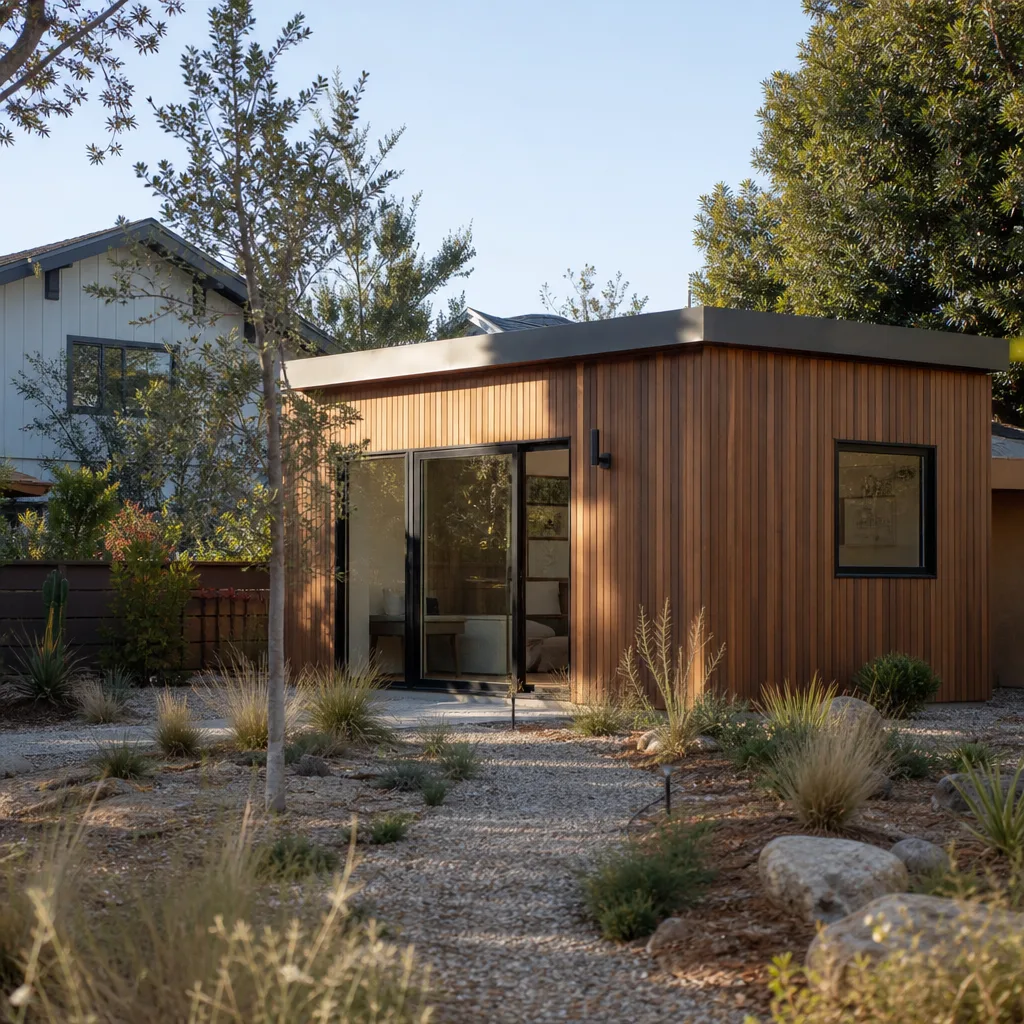
For a Ventura garage conversion ADU, expect to pay $4,800 to $11,500 for full James Hardie cladding and trim replacement. A single wall or trim repair runs $850 to $2,400. A reclad of a standard 20×20 detached garage converted to an ADU with HardiePlank lap siding and HardieTrim corners lands around $7,000 to $9,500.
What drives the range: whether we’re painting after installation (we include color-matched factory or field finishing, but a full repaint adds cost), condition of the sheathing underneath, how much scaffolding or lift access is needed, and whether the existing product can be matched or we’re recladding to a current profile. Paint-grade HardiePlank is the most affordable path; the ColorPlus factory-finished line costs more per board but skips the painting step entirely and carries a 15-year finish warranty from James Hardie.
Every quote from Benson ADU Ventura is a written, line-item price before work starts. You’ll know the board count, the trim count, the labor, and the finish. No verbal estimate. No change order after demo. Our 365-Day Done Right Promise covers the installation for a full year, and Troy Eastman puts it in writing on every single project.
DIY or Call Us?
You can safely check a few things yourself: run your hands along the bottom edge of the siding where it meets the roof or ground, look for cracked caulk at window jamb intersections, and note any boards that feel soft under thumb pressure. That inspection helps you know whether you’re looking at a few bad boards or a system-wide problem, and it helps us give you an accurate phone estimate.
The DIY install is where it goes sideways. Fiber cement is heavy, brittle at cut edges, and requires specific fasteners, joint flashing, and clearance gaps that Ventura building inspectors do check on ADUs. A wrong cut on a 12-foot HardiePlank is a $35 dead board. Get the flashing sequence wrong on a garage conversion and the wall rots silently for three years before you see a single stain. We’d rather you call (350) 207-2506, let us look, and get a written number. If it turns out to be a $900 trim repair, we’ll tell you that. If it’s full reclad territory, we’ll show you the scope in writing before you commit to anything.
FAQs
James Hardie fiber cement siding lasts 30 to 50 years when installed correctly with proper gaps, flashing, and fasteners, but the paint or ColorPlus finish needs attention every 10 to 15 years in Ventura’s coastal environment. The boards themselves rarely fail; it’s installation shortcuts and poor flashing that shorten the life.
Yes, isolated boards and trim pieces can be cut out and replaced individually, which is often the right call for water damage confined to one wall or window corner. If multiple sections are failing or the sheathing behind the siding is soft, we’ll walk you through the math on repair versus reclad honestly. Call (350) 207-2506 for an exact look at your conversion.
Most single-room or single-wall repairs on Ventura garage conversions finish in one to three days, including cleanup. A full garage conversion reclad with trim typically runs five to eight working days depending on access and weather windows, and we give you a written schedule before we start.
We stock common HardiePlank profiles in both 5/16″ and 7/16″ thicknesses, HardieTrim boards, corner pieces, and the correct flashing and fasteners on our trucks, so most single-part replacements don’t wait on a supply house run. We also build with complementary prefab brands like Abodu, Cover, and Dvele when a full ADU build is part of the conversation, but for cladding repair, genuine James Hardie is what we install.
Written by Troy Eastman, Owner & Lead Builder at Benson ADU Ventura, serving Ventura and nearby areas. Put it in writing before the first shovel moves – that’s not fine print, that’s just how good work starts.